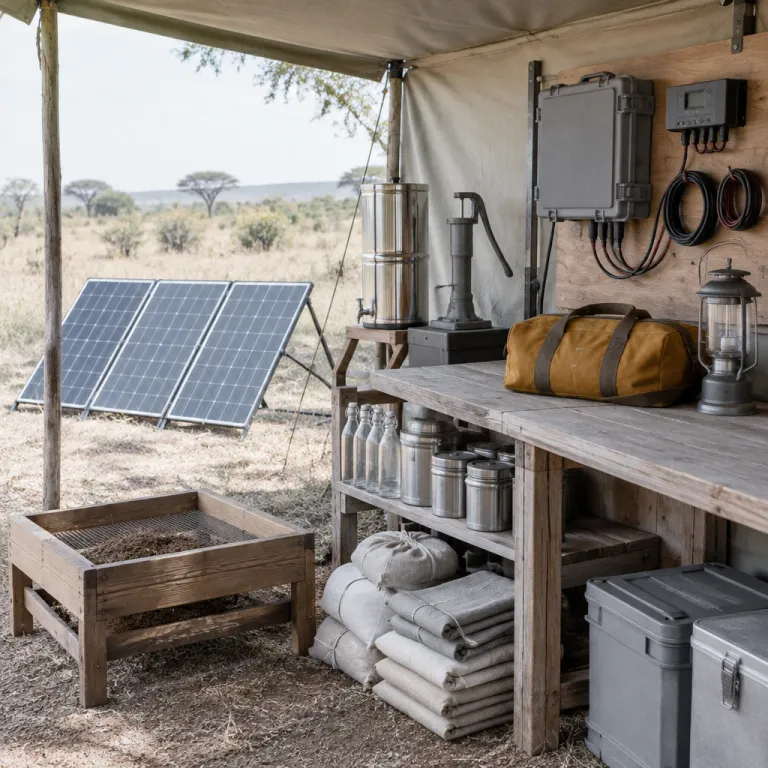
Why the new luxury benchmark is an off grid solar safari camp
The most interesting luxury in the bush now is silence at night. A serious off grid solar safari camp trades the thump of diesel for a low hum of inverters, using carefully sited solar panels and high density battery storage to keep the experience both indulgent and low impact. When you are choosing between lodges, ask how many watts of installed solar panel capacity they run, how many watt hours of storage they hold, and how many hours they can operate without a generator.
Remote concessions in Botswana, Zambia and northern Kenya increasingly operate as a refined grid solar micro village, with a central power station feeding guest tents through buried cable and discreet power panel boxes. The best properties publish their power data, explaining how many watts of solar panels they use per guest and how much diesel expansion capacity they have kept as a safety net. When a manager can talk clearly about the price of each extra watt solar installed versus the long term fuel price, you know the sustainability story is more than marketing.
For a business leisure traveler, this matters because quiet, stable power shapes sleep, work and rest. You can charge a laptop from a clean battery pack while a lion roars outside, without the vibration of a generator under the deck. That is the essence of an off grid solar safari camp done properly, where power is abundant enough to feel free yet carefully rationed behind the scenes so the ecosystem, and your conscience, stay light.
How sun and storage actually keep the camp running
Behind the canvas and copper taps, a serious engineering story keeps your tent lit. A typical off grid solar safari camp will run a bifacial solar array on a cleared patch near staff quarters, with each watt panel angled to catch both direct sun and reflected light from pale Kalahari sand. Those bifacial panels feed a bank of lithium battery modules, sized in tens of thousands of watt hours, which then supply low voltage power to guest tents for lights, fans and discreet charging sockets.
Many camps now use technology familiar from high end portable solar systems, scaling up brands you might know from home. You will hear managers talk about an EcoFlow style power station architecture, an Anker Solix inspired expansion battery design, or a Bluetti solar inverter stack, not because they bought those exact units but because the modular logic is similar. In practice, each tent might have its own small power panel with a dedicated battery pack, while the main lodge runs on a larger central station that can be isolated if a cable fails.
When you read about Zambia’s new luxury lodge collection that puts rewilded lions at the centre of the deal, you will also notice how many of those properties now specify their solar panel capacity and battery autonomy as part of the conservation narrative. A camp that can run for 24 to 48 hours on stored watts without firing a generator protects both the soundscape and the predators that hunt by ear. For you as a guest, that means air conditioning may be limited, but hot water, cold wine and reliable lighting are non negotiable, delivered by a carefully balanced solar and storage system.
Water, waste and building light in a remote concession
Power is only one part of the off grid equation in a serious safari camp. Water usually comes from a borehole drilled deep below the sand, then pushed through a filtration station that removes sediment and pathogens before it reaches your copper shower rose. Every litre is counted, and the best operators will explain how many hours of pump time their solar panels can support each day and how that shapes laundry schedules and pool top ups.
Waste is handled with the same discipline, because there is no municipal truck arriving at the back of the kitchen. Food scraps go to compost or carefully managed pig farms in nearby communities, glass is crushed and packed out by weight, and single use plastic is treated as a failure of strategy rather than a convenience. When a lodge talks about its waste policy with the same precision it uses to describe its watt solar capacity, you are hearing the language of a mature off grid solar safari camp rather than vague eco promises.
Building light is the final piece, and it starts long before you arrive. Many of the most interesting properties now use raised decks, canvas and timber that can be removed at the end of a lease, leaving only a faint grid of post holes in the soil. If you want a deeper dive into how luxury eco safari lodges combine wildlife, sustainability and elegance, the analysis of luxury eco safari lodges on SafariLodgeStay shows how low impact construction, careful siting and solar panels together define a new standard of African hospitality.
Guest experience: quiet luxury, gentle limits and real comfort
Life in an off grid solar safari camp feels subtly different from a city hotel, and that difference is the point. Nights are genuinely dark and quiet, with only the soft click of a fridge compressor and the distant cough of a leopard, because the main power station is running on batteries rather than a diesel engine. You may be asked to charge cameras and laptops during the day, when the solar panels are producing surplus watts, and to keep hairdryers and other high draw devices to certain hours.
For a business leisure traveler, this is less of a constraint than it sounds. Most camps now provide a dedicated charging table near the lounge, often powered by a robust portable power station that would not look out of place in a high end overlanding rig. You will see familiar language on the back of the unit, referencing watt hours, expansion battery options and even an Anker Solix or Jackery Explorer style architecture, but here it is quietly doing the work of keeping cameras, binoculars and laptops ready for the next game drive.
Some properties go further and place a compact portable solar kit in each tent, with a small fold out solar panel, a tidy battery pack and a neatly coiled charging cable in a canvas carrying case. This ultra portable setup lets you top up a phone or e reader on your private deck, while the main grid solar system looks after fridges, freezers and water pumps. The result is a stay that feels indulgent yet grounded, where gentle nudges on water use and charging habits become part of the story rather than an irritation.
How to read the tech and separate substance from greenwash
Marketing language around sustainability has become as dense as mopane woodland, so you need a clear way to navigate it. When a lodge claims to be an off grid solar safari camp, ask for specifics on installed solar panel capacity in watts, total battery storage in watt hours and how many hours they can run without a generator. A serious operator will be comfortable talking about the price of their last solar expansion, the expected life of their batteries and the maintenance schedule for their inverters.
It also helps to understand the consumer technology references you will increasingly hear around the fire. If a manager mentions EcoFlow style systems, Jackery Solarsaga panels or Bluetti solar inverters, they are signalling a move towards modular, serviceable hardware rather than bespoke one off builds that are hard to repair. You might see a ruggedised Jackery Explorer unit used as a backup power station in a vehicle, an Anker Solix inspired portable power cube in the photographic hide, or a compact watt panel on a staff tent, all of which show that the camp is thinking about redundancy and resilience.
Look as well at how the camp talks about logistics and impact beyond power. A property that explains its waste pack out policy, its relationship with local recycling stations and its plan for removing structures at the end of a lease is usually more serious than one that only mentions free range eggs and organic soap. When you are weighing whether to stay in one camp for five nights or to hop between several, the analysis of a single destination safari on SafariLodgeStay offers a useful framework for judging how deeply a lodge has integrated sustainability into its operations rather than treating it as a marketing line.
FAQ
Will an off grid solar safari camp have reliable electricity for work and charging ?
Well run camps design their solar and battery systems around predictable guest loads, so you can usually charge laptops, phones and cameras without issue. The main limitation is on very high draw devices such as hairdryers or travel kettles, which may be restricted to certain hours or not allowed at all. If you plan to work, ask the lodge for details on available sockets in tents, quiet work spaces and typical overnight battery autonomy.
Are off grid solar safari camps more expensive than traditional lodges ?
The upfront price of building a solar powered camp is higher than installing a diesel generator, but operating costs fall over time as fuel use drops. For guests, nightly rates are usually comparable to other luxury properties in similar concessions, because the capital cost is spread over many seasons. When comparing options, focus less on a small difference in price and more on the quality of guiding, location and the depth of the sustainability programme.
Will I have air conditioning and all night power in a solar powered tent ?
Most off grid solar safari camps prioritise fans, good cross ventilation and thoughtful design over full air conditioning in every tent. Some high end suites may offer limited air conditioning during peak heat hours, but running it all night would drain batteries and undermine the sustainability model. You can expect reliable lighting, charging points and hot water, with clear communication from the lodge about any time based limits.
How do these camps manage water without a municipal supply ?
Remote lodges typically drill a borehole, pump water using solar powered pumps and then filter it for drinking and washing. Grey water from showers and basins is treated and often reused for irrigation, while black water goes into sealed septic or advanced treatment systems designed for sensitive environments. Guests are usually encouraged to take shorter showers and reuse towels, but you will still have access to comfortable, well pressured bathrooms.
Is staying in an off grid solar safari camp actually better for conservation ?
Running on solar and batteries reduces noise, emissions and fuel transport through fragile ecosystems, which directly benefits wildlife and local communities. The most committed operators pair this with strong anti poaching support, community employment and long term land lease agreements that make wildlife more valuable alive than hunted or grazed. When you choose such a camp, you are supporting a model where high end tourism underwrites both habitat protection and local livelihoods.